At the end of December I was lucky to travel to Berlin with my wife. Lucky both because, hey, it was Christmas in Berlin and because my wife speaks German. Lucky also because we spent most of a day touring Berlin's famous Jewish Museum, which quickly took over the top spot on my favorite museums list. As I've attempted to explain what it was I liked so much about the museum I keep coming back to three aspects of my visit. I will cover these in three short posts as opposed to one long one...
 |
"Fallen Leaves" - Menashe Kadishman
(photo cr. Florence) |
1. The Experience of Absence
The Jewish Museum's central originality is the way it organizes an
interpretive experience of absence to communicate an
historical experience loss. The immediate point of comparison for me, and for most American visitors, is The Holocaust Memorial Museum in Washington, D.C. If The Holocaust Museum taught me the power of museums, The Jewish Museum taught me their humanity, and how they might be essential.
The Jewish Museum organizes this interpretive experience in three ways, and the
first is very explicit. Somewhere in almost every room a sign will remind you to consider the voices missing from modern Berlin. We are told right away that, today, there are about 100,000 Jewish residents of Berlin and that in 1930 the city's Jewish population had been about 200,000. We are reminded again in the final galleries of the exhibit.
 |
| "The Gallery of the Missing" |
Second, throughout the exhibit visitors are encouraged to linger in empty spaces. Sometimes these are alcoves that display artists' representations of absence. Some are corridors that offer only the disorienting experience itself; home to nothing but too redundant to be shortcuts. When these turn a corner overlooking Menashe Kadishman's, "Fallen Leaves", the experience is immediate, sustained and dramatic. When they bring us face to face with black "marble" radio installations featured throughout "The Gallery of the Missing" the experience is frustration, confusion, even anger. A sign reminds you to listen for what you do not hear as you struggle with a faulty headset.
 Third,
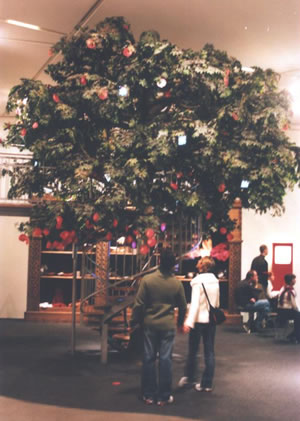
 these sensory-emotional experiences support the intellectual experience of learning an enormous amount about the history of Jews (and Judaism) in Germany. That story begins around 300 AD. In another context the scope of information confronting a visitor could feel daunting, but at the Jewish Museum the weight of historical narrative is balanced by a more contemplative dimension. As we enter, visitors are invited to hang wishes on an artificial pomegranate tree. Invitations to rituals like this one create space for visitors to reflect on the museum's historical narrative and provide tools to help us navigate the experience of absence.