He feared that [formal training] filled people up with jargon, and then they just classified things rather than looking at them.
Wednesday, February 12, 2014
Thomas P. Campbell's TED Talk on Interpretation at The Met

Tuesday, February 11, 2014
Whose Legacy?

The $6.5M from which I draw my (almost-) fraction is itself only about 9% of approximately $75M set aside for Legacy projects each year. The Outdoor Heritage & Clean Water Funds each earn 33% annually. The Arts & Cultural Heritage Fund earns 19.75%, about half of which goes directly to Minnesota Historical Society programming, and the Parks & Trails Fund get 14.25%. The percentages seem reasonable even if they adhere to a certain inevitable logic of policy-making, but it still comes as a surprise to learn that "Outdoor Heritage" means that a single private non-profit organization has received $45M in Legacy funding since 2009 to make land and easement purchases. MinnPost wants to know, "whose legacy will taxpayers really end up supporting?"
Several possibilities spring to mind. The first is that Minnesota's Legacy Amendment has created a windfall for private organizations that not many people know much about. A second is that this is not surprising after voting to set aside about $25M annually that "may be spent only to restore, protect, and enhance wetlands, prairies, forests, and habitat for fish, game, and wildlife." Third is that much of what we do know about projects funded by Legacy money is omitted from discussions like these. And fourth, simply and broadly, acts of remembering our heritage also become part of our heritage.
* * *
"Helmer Aakvik"
On Sunday night at The Cedar Cultural Center, a Legacy project took the stage and played songs drawn from Minnesota history and folklore for about 300 enthusiastic fans. Joey Ford received a 2013 Artist's Initiative Grant from the Minnesota State Arts Board, the state agency that distributes the bulk of Legacy's Arts & Cultural Heritage money. The grant paid for Joey's band, Tree Party (better known as The Poor Nobodys), to travel around Minnesota, visit small museums and chat with locals, write songs drawn from the stories they heard, record an album and host Sunday's concert. Joey delivers Marty Robbins-flavored story songs about Minnesota folk heroes like Dorothy Molter, Wrinkle Meat, John Beargrease and Helmer Aakvik. His liner notes conclude,
Our history lives in the voices of old-timers and sits in small town museums, waiting for us to find it.
Friday, February 7, 2014
Watching the Opening Ceremonies With David Lowenthal
Tonight I invited David Lowenthall over to watch the Opening Ceremonies of the 2014 Winter Olympics. We played a drinking game where we drank beer from Minneapolis while we watched the same interpretation of Russian history seen by millions around the world.

Dave pounded his Day Tripper and observed:

Venerated as a fount of communal identity, cherished as a precious and endangered resource, yesterday became less and less like today. Yet its relics and residues are increasingly stamped with today's lineaments. We may fancy an exotic past that contrasts with a humdrum or unhappy present, but we forge it with modern tools. The past is a foreign country whose features are shaped by today's predilections, its strangeness domesticated by our own preservation of its vestiges.Then the local news came on and it turned out that the past is a foreign country in south Minneapolis.
Thursday, February 6, 2014
Local Events: The History of Hip at the Turf Club

For one thing, the Minnesota Historical Society is not often cited as an arbiter of hipness, historical or otherwise. Institutions like MHS confer a different kind of cultural value on the events and sites they interpret; they select particular aspects of popular culture to exhibit for an exclusive audience. MHS hopes that this series will draw first time visitors to the Clown Lounge, and that people who have never been to the MN History Center might attend this event because of its setting. Which is awesome. But bridges between institutions can also isolate them from a broader community, separating culture from public culture to paraphrase a smart friend.
At an institutional level this separation seems inevitable. At the Clown Lounge on Tuesday it was more difficult to discern. The crowd was a little different from normal - mostly seated; mostly sober - but MHS is working hard to treat these events like a community meeting. Priority goes to local voices and the audience. At each of the first two History of Hip programs we had conversations with local brewers and distillers about their experiences living and working in the Midway. An historian is on hand to provide some context, but the important details were manifest as discussion. When nobody could remember the name of the distributing company on Prior that used to be Griggs-Cooper, our bartender shouted out, "Mark VII!"
"We buy from them," he explained.
* * *
A few more words from our bartender might have helped us measure our proximity to or distance from public culture at the Clown Lounge. The club has struggled to keep its doors open in recent years, and three months ago First Avenue took over operations. The sale means that the Clown Lounge will continue to function as a cultural center for the Twin Cities community for the foreseeable future. Meanwhile, another iconic club that was forced to close its doors in Minneapolis' West Bank neighborhood is hoping for a similar result from a similar institutional partnership. The 400 Bar is planning to re-open in June on the fourth floor of the Mall of America. The venue will be part of a 25,000 square foot entertainment complex that will also feature a restaurant as well as the brand new Midwest Music Museum.

Thursday, January 30, 2014
Bonus Song of the Month: Pete Seeger - "The Phoenix and the Rose"
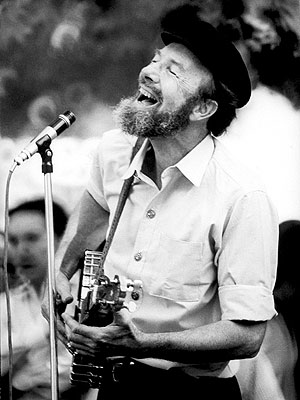
Pete Seeger & Ed Reenhan - "The Phoenix and The Rose"
I loved this song when I was 8 years old. I loved the story, and I especially loved the way Pete told it. And I still do. I love the marching, mocking, formality and the perfectly petty British: "into the vacant stores they stormed/in search of things for tea." I love how the sailors "cursed the town in language unrestrained", and when I was 8 years old I especially loved the way Pete trusted me to understand that line.
This was a huge part of Pete's gift. He trusted children to understand adult complexities and he trusted adults to find wisdom in the experiences of childhood. His songs give us a language for speaking in meaningful ways to children and adults at the same time. Anyone old enough to have made an excuse should empathize with the steward on The Phoenix.
It's been quite a busy day sir, what with all the shelling
and the raiding and the burning, and the general raise-helling//
//there's been precious little time to spare for foraging and looting
because of which aboard this ship of some four and forty guns
there was not a single thing to eat, but some carrots and stale buns
Friday, January 24, 2014
Song of the Month: William Tyler - "Country of Illusion"
Nobody likes getting told what to think. William Tyler's lush guitar arrangements are calibrated to provoke an emotional response, but they leave plenty of space to welcome each listener's unique reaction. On Wednesday night he closed his set at The Cedar with this song, "Country of Illusion." He introduced it by sharing context, not answers. Here is my attempt to paraphrase:
A lot of times people think that because my songs don't have any words they're not about anything, but that's not really true. Sometimes my songs are about relationships or whatever, sometimes they're just evocative of a landscape. This song I wrote during a long road trip and I was reading a book about peak oil...I was thinking a lot about how a lot of the country thinks things are this way and they can't imagine how they could be any other way....
And I also think that we just have a lot of nostalgia, and a lot of that's cultural and a lot of that's personal. So I'm just trying to reconcile some of that.
Saturday, January 18, 2014
Preservation: A Case of Triage

In northern Italy, melting glaciers have exposed the mummified bodies of World War I soldiers who died in battle at 12,000 feet of elevation. The story is fascinating: "shelling lowered the summit of one mountain, San Matteo, by 20ft." In recent decades, "[m]ore than 80 soldiers who fell in the White War have come to light." A curator at the historic monument at 6,500ft hopes that "intrepid hikers will be able to visit...and, as he puts it, 'smell the war'."
Researchers are still struggling to identify the names of the soldiers they have recovered, and search parties have hunted for the body of Italian captain Arnoldo Berni for almost a century without success. Glacier archaeologists, however, are accustomed to these sorts of obstacles. [Excerpt]
Glacier archaeology, as the field is called, has been referred to as the silver lining in the cloud of global warming...But it is a race against time. As soon as organic material melts out of the preserving ice and is exposed to the elements again, it starts to decay...The sheer amount of material now in this precarious condition -- Swiss glaciers, for example, have lost a third of their volume since 1860 -- means that archaeologists simply cannot reach it all in time, not least because it is often inaccessible outside the narrow window of summer at these altitudes. It's a case of triage, says [Craig Lee at the University of Colorado, Boulder.]Even when the past reveals itself to us most directly, we cannot recover - let alone study or evaluate - the full revelation. This will always be true about the past. Meanwhile, the fact that these recovery efforts require racing against melting glaciers suggests that triage also operates on a geologic scale. It reminds me of William Cronon's thoughts about preserving wilderness.
If visitors come [to the Apostle Islands] and believe that they are experiencing pristine nature, they will completely misunderstand not just the complex human history that has created the Apostle Islands of today; they will also fail to understand how much the natural ecosystems they encounter here have been shaped by that human history. In a very deep sense, what they will experience is not the natural and human reality of these islands, but a cultural myth that obscures much of what they most need to understand about a wilderness that has long been a place of human dwelling.What set of priorities allows us to understand preservationist archaeology as a silver lining to climate change? Partly it is the cultural myth of a pristine past, free from present day challenges. These glaciers remind us that the past will always be a place of human dwelling.
Subscribe to:
Posts (Atom)